

June - Integration
A seasonal letter shared at first light each month — a quieter space to pause, notice, and make sense of our experiences.

Integration is often the part we overlook.
Continuing professional development is full of moments of insight. We attend conferences, read books, listen to podcasts and leave with new ideas. We have powerful conversations with colleagues. We encounter stories that challenge our assumptions. We discover tools that seem full of possibility.
Yet insight alone rarely creates change.
The real challenge is integration.
How do we take what we have learned and weave it into our everyday consultations and conversations?
How do we integrate new ways of seeing, listening and responding into the realities of day-to-day practice?
And how do we integrate ourselves more meaningfully into the wider system around us?
Over the past few years, a simple pattern has gradually emerged across much of the work within Wild-Ness Health:
Notice → Make Sense → Reimagine → Integrate → Repeat
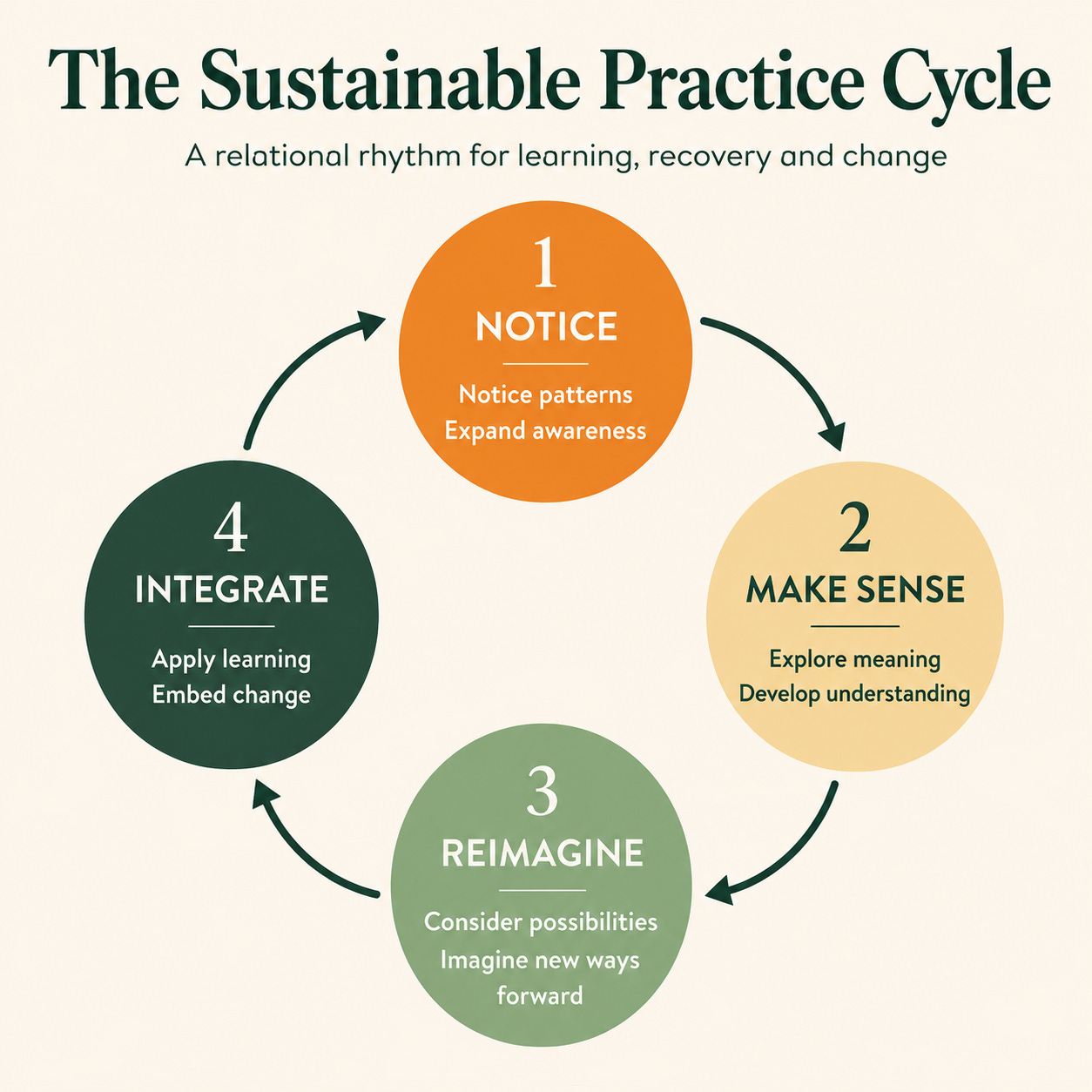
Image 1 — Sustainable Practice Cycle
The Sustainable Practice Cycle: Notice → Make Sense → Reimagine → Integrate → Repeat. Created by Dr Kath Jones using digital tools
What has become known as the Sustainable Practice Cycle was never designed as a formal model. Rather, it emerged through clinical practice, NHS quality improvement work, lived experience, creative collaboration and conversations with health professionals across the UK.
At first glance, integration can appear to be the final stage of the cycle.
But integration is not the end of the journey.
It is the beginning of the next cycle.
Health is not a fixed state that we achieve once and for all. Learning does not move in a straight line. Both are cyclical processes.
We notice something.
We begin to make sense of it.
We imagine new possibilities.
We try something different.
We integrate what works.
And then life changes, circumstances shift and new challenges emerge. With a new layer of understanding, we begin the cycle again.
Perhaps this is another meaning of integration.
Not simply adding another tool, pathway or intervention, but bringing separated parts back into relationship.
Integration within ourselves
For many people living with persistent physical symptoms, difficulties with emotional regulation or neurodivergent experiences, life can begin to feel fragmented.
Symptoms can leave us feeling disconnected from ourselves and from those around us.
Experiences that initially seem unrelated can accumulate over time.
The story no longer makes sense — to us, or to the people who care for us.
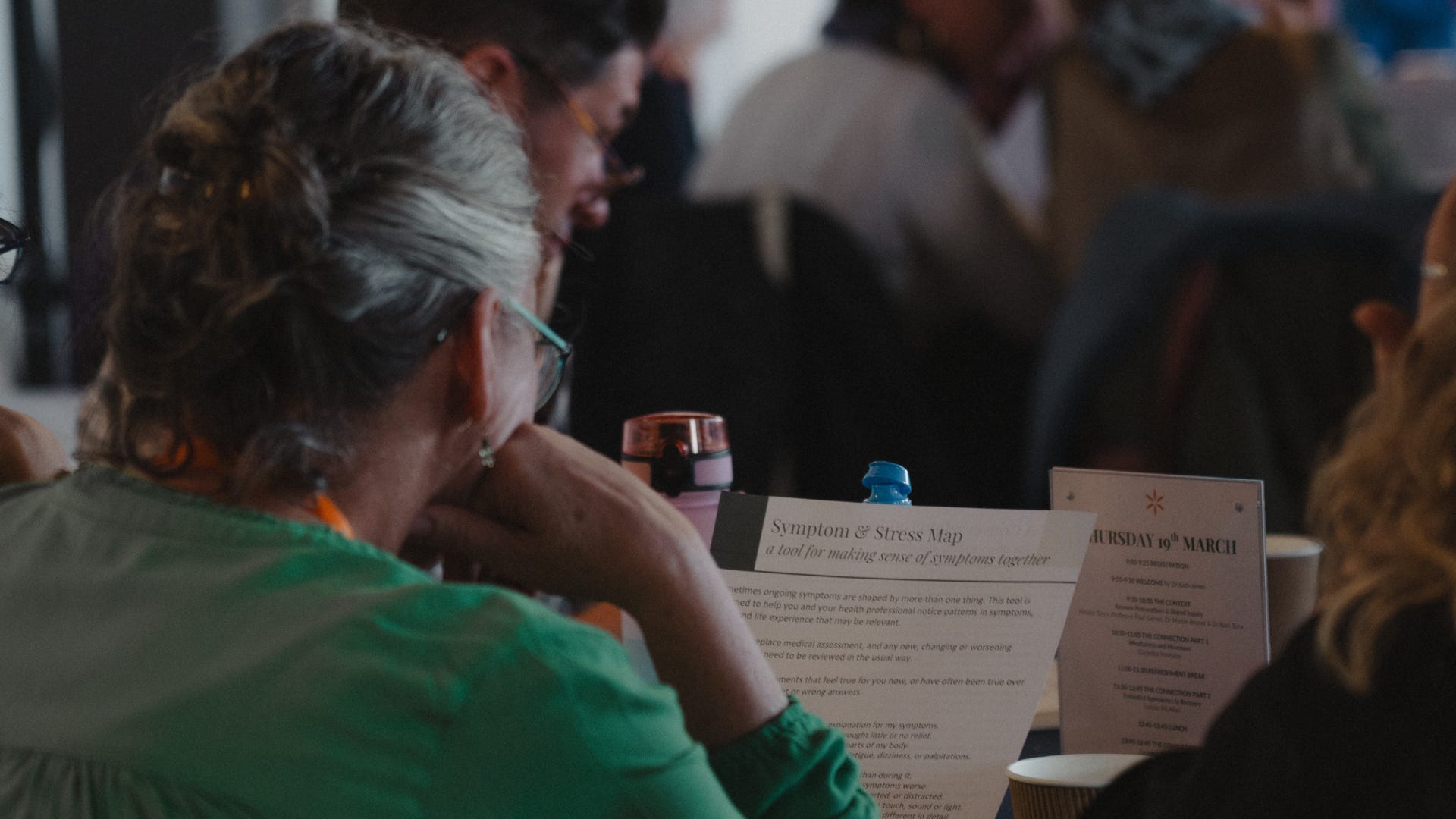
Image 2 — Symptoms and Stress Map
Exploring the Symptoms and Stress Map at The Sustainable Healer conference in March 2026. Photo: Jake Gilbert
One of the simplest tools within the Sustainable Practice Toolkit is the Symptoms and Stress Map.
Rather than asking, “What is wrong with me?”, it invites people to begin connecting experiences and symptoms that may previously have felt unrelated.
When do symptoms flare?
What was happening in the days, weeks or months beforehand?
What pressures, responsibilities, relationships, emotions or life events might have been present?
What patterns begin to emerge when these experiences are seen together?
The aim is not to suggest symptoms are imagined or “all in the mind”. Rather, it is to support people to notice patterns, make sense of their experience and explore the possibility that symptoms may reflect a nervous system that has become stuck on high alert.
For many people, this process creates a different starting point.
Symptoms begin to feel less random.
Experience begins to feel more connected.
And new possibilities begin to emerge.
Over time, this can support people to reimagine another way forward and begin integrating new habits, new narratives and new activities into their lives.
Integration within the therapeutic relationship
Integration can also occur within the consultation itself.
At its best, healthcare is not simply the delivery of expertise from one person to another. It is a process of making sense together.
This requires us to bring different forms of knowledge into relationship.
Professional knowledge and patient wisdom.
Evidence and lived experience.
Curiosity and compassion.
Hope and realism.
When these perspectives are held together rather than placed in opposition, new possibilities often emerge.
Not because we have found all the answers, but because we have created enough space to see more of the whole picture.
Integration within the wider system
Health is shaped by much more than healthcare.
One of the things I have loved the most about Wild-Ness Health events over the past three years is the breadth of experience in the room. Health professionals, creatives, researchers, people with lived experience and those working in the third sector have all brought a richness to the dialogue that would not have been possible from within healthcare alone.
This has shaped my own practice too.
In particular, my connection with the charity Flip of the Coin has transformed how I think about what becomes possible when healthcare and community organisations work alongside one another. I first came to know the organisation through my work as an NHS GP and have since become one of its trustees.
Their creative workshops now take place within view of my consulting window.
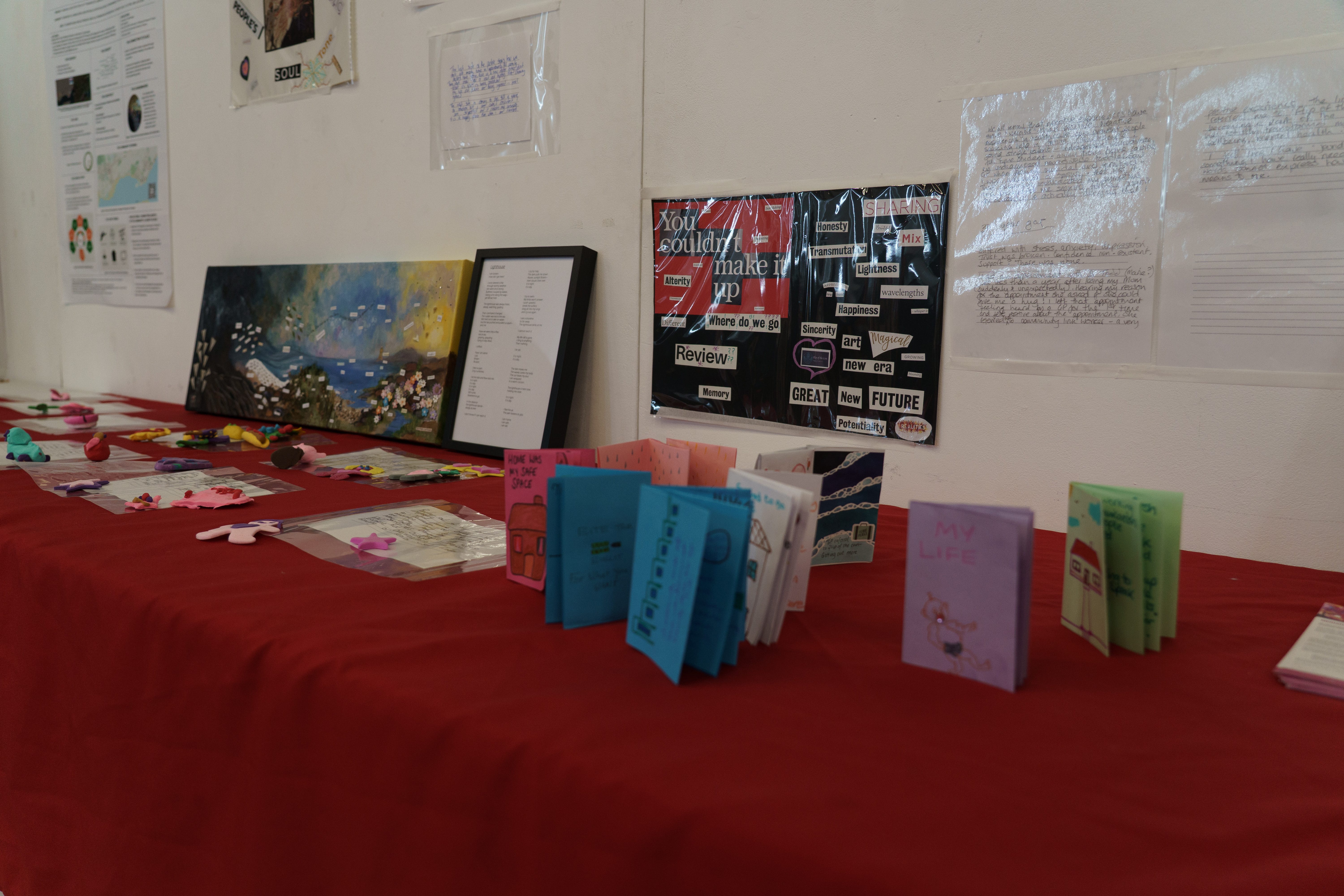
Image 3 — Flip of the Coin artwork
The Healing Landscapes exhibition at The Sustainable Healer conference, March 2026, exploring what supports health and recovery beyond the consulting room. Photo: Jake Gilbert.
For some people whose lives have become so restricted that the only places they regularly leave the house for are the doctor’s surgery, and perhaps the shops on a good day, that can make all the difference.
This collaboration has taught me about a third form of integration.
Not simply integrating learning into consultations, but integrating healthcare into the wider web of relationships, places and opportunities that support health and recovery.
This week I will be exploring some of these ideas at the North Lanarkshire Creative Health Conference in Airdrie alongside Lucy Campbell, Founder of Flip of the Coin and Community Embedded Researcher for REALITIES III, and Dr Marisa de Andrade, Principal Investigator of this UKRI-funded research programme.
Together we will be reflecting on what becomes possible when healthcare, creativity and community are brought into closer relationship, particularly in communities experiencing significant health inequalities.
The more I reflect on the Sustainable Practice Cycle, the more I realise that it describes not only how we learn as professionals but also how many people recover, adapt and grow.
Whether we are navigating persistent physical symptoms, emotional distress, neurodivergent experiences, professional burnout or organisational change, the process often carries a similar rhythm.
We notice what is happening.
We begin to make sense of it.
We imagine what else might be possible.
We integrate what helps.
And then, slowly and imperfectly, we begin again.
Perhaps this is why the Sustainable Practice Cycle seems to resonate across conferences, consultations, coaching conversations, community projects and creative spaces. It does not belong to any one of them. It simply reflects something deeply human: the ongoing work of integrating what helps into the lives we are already living.
Until next month,
Kath
Dr Kath Jones
GP, Founder of Wild-Ness Health
Explore the Sustainable Practice Toolkit
The Symptoms and Stress Map is one of the practical tools included in the Sustainable Practice Toolkit, created to support reflection, sense-making and more sustainable conversations in everyday practice.
Join the Learning Library
Free membership includes Letters from the Library, introductory resources and invitations to Meet the Librarian, a free monthly online drop-in for reflection, questions and conversation.